
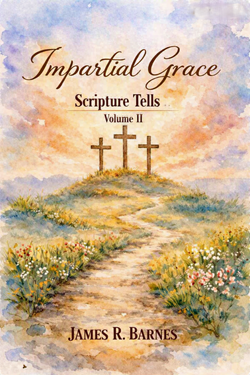
In Impartial Grace: Scripture Tells…, James R. Barnes invites readers to rediscover the plain meaning of God’s Word—unfiltered by tradition, untouched by denominational rivalry, and unburdened by fear. These meditations trace the thread of divine mercy woven through every book of Scripture, revealing a God whose love is not partial, whose grace is not conditional, and whose purpose is to reconcile all things to Himself. Written with the heart of a preacher and the clarity of a teacher, Impartial Grace calls believers back to the simple, courageous practice of being Christian: to love, to trust, and to rest in the sufficiency of Christ. (Sample Chapter)
Introduction
I came to believe that Impartial Grace is a doctrine worthy of careful attention because it bears faithful witness to God’s ultimate purpose for those He has created. With humility, and after much prayer and study, I have become persuaded that it is His intent, His plan, and His will that all creation be reconciled to Him through Christ Jesus. Scripture affirms that God was pleased “through Him to reconcile all things to Himself” (Colossians 1:19–20). No person stands outside the reach of His steadfast and relentless love, for nothing “will be able to separate us from the love of God in Christ Jesus our Lord” (Romans 8:38–39).
Impartial Grace reflects the pure and undivided nature of God’s love, for “God is love” (1 John 4:8). This understanding—often referred to as universal reconciliation—rests not on novelty, but on Scripture that is both abundant and consistent. Where other doctrines lean heavily on inherited traditions, Impartial Grace seeks its footing in the revealed character of God and in the testimony of His Word, mindful that traditions can, at times, set aside the command of God (Matthew 15:9).
My study led me to reconsider much of what I had been taught about the scope and purpose of Christ’s death on the cross. Scripture declares that Christ “gave Himself as a ransom for all” (1 Timothy 2:6) and that He is “the atoning sacrifice…for the sins of the whole world” (1 John 2:2). These are not isolated statements, but part of a larger biblical witness that speaks of “grace upon grace” (John 1:16) and of mercy that endures forever (Psalm 136). Over time, these passages invited me to look again—more slowly, more openly—at what God has revealed.
I first shared my study of Scripture on Impartial Grace in a book written in 2018. The pages that follow are drawn from that work. I was helped by a compilation of passages assembled by David Sprenger, pointing toward what many call universal reconciliation. His list was not exhaustive, but it served as a guide—always subordinate to Scripture itself and to the Spirit’s instruction through it.
“In the beginning…” God created the heavens and the earth (Genesis 1:1). He created every living thing—those on the land, in the seas, and beneath the earth. All things were created through Him and for Him (Colossians 1:16), and He remains sovereign over all that He has made (Psalm 103:19). If Impartial Grace is true, its proof must be found within God’s Holy Word. It cannot stand apart from Scripture, nor can it coexist with doctrines that contradict God’s revealed nature—that He is sovereign, that He is love, and that He does not change (Malachi 3:6).
The opening chapters of Genesis present an all-powerful God creating the universe from nothing. Everything He creates is declared “very good” (Genesis 1:31). He forms the first man from the dust of the ground and breathes into him the breath of life (Genesis 2:7). In love, He creates a helpmate from the man’s side. God also, in His foreknowledge, creates the conditions that lead to what we call “The Fall.” He places the tree in the midst of the garden, allows the serpent to speak, and permits the choice that leads to disobedience—none of which occurs outside His sovereign knowledge and purpose (Isaiah 46:9–10).
Scripture does not dispute that Adam and Eve disobeyed God and that consequences followed. The judgment pronounced was physical death: “For dust you are, and to dust you shall return” (Genesis 3:19). While many assert a spiritual death as well, such claims must be weighed carefully against the whole counsel of Scripture.
Traditional theological systems often converge on the doctrine of eternal conscious torment. Universal reconciliation affirms instead that “as in Adam all die, so also in Christ shall all be made alive” (1 Corinthians 15:22). Confession of faith in Christ Jesus remains essential (Romans 10:9), judgment is real (Hebrews 9:27), and yet Scripture plainly teaches that God “desires all people to be saved” (1 Timothy 2:4) and is “not willing that any should perish” (2 Peter 3:9). Through Christ, God will reconcile all things to Himself (Colossians 1:20), bringing His purposes to their intended and glorious completion.
This book was not written quickly, nor was it written to win arguments. It is the result of years spent reading Scripture slowly, returning to familiar passages again and again, and allowing the text to speak for itself—even when its voice challenged assumptions I once held without question.
What began as questions eventually became convictions. What began as tension settled into clarity. I did not set out to defend a system, a denomination, or a tradition, but simply to follow the biblical witness wherever it led. That journey revealed a consistent theme running from Genesis through the prophets, the Gospels, and the letters of the apostles: God’s purposes are restorative, His judgments are meaningful, and His mercy is wider than human fear allows.
This work is offered as a testimony rather than an argument—an invitation rather than a reaction. It is written with deep respect for those who see these matters differently, and with gratitude for the teachers, scholars, pastors, and writers—past and present—who have wrestled honestly with Scripture before us.
I have come to believe that theology is ultimately doxology: what we believe about God shapes how we worship Him, how we see others, and how we live in the world. If this book succeeds in anything, I hope it is in pointing readers back to the text of Scripture itself and to the God who is revealed there—faithful, sovereign, just, and unfailingly loving.


